Building an Inclusive Meeting Culture for Global Teams
Transform your meeting culture to be truly inclusive. Learn how meeting fairness is a DEI issue, how to measure it with data, and practical steps to create equitable scheduling practices this week.
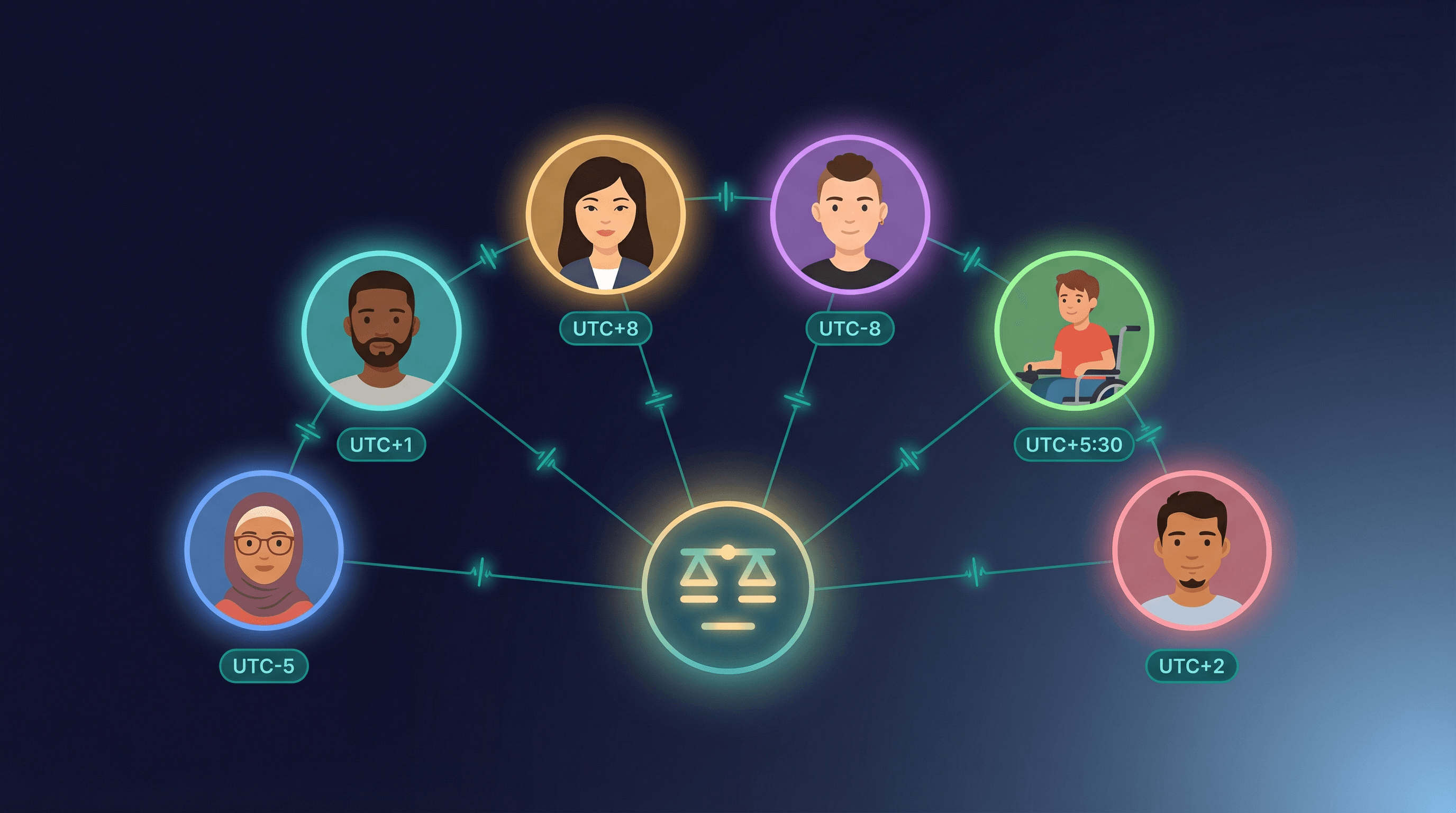
Meeting Scheduling as a DEI Issue
Most companies think of DEI (Diversity, Equity, Inclusion) as hiring, promotion, and pay equity—all critical. But there's a structural equity issue that's barely discussed: meeting scheduling bias. When a company is headquartered in San Francisco and has satellite offices or remote workers in London, Tokyo, and São Paulo, the default meeting times unconsciously drift toward San Francisco convenience. Over months, this creates a systematic disadvantage for anyone not in the HQ timezone.
Consider the cumulative impact: a London employee joins meetings at 4am once per month (sacrifice score: 9), a Tokyo employee at 1am (sacrifice score: 10), a São Paulo employee at 7pm (sacrifice score: 6). A San Francisco employee joins at their golden hours (sacrifice score: 1). Over a year, the non-HQ employees are bearing 25x more meeting sacrifice. They're not complaining individually—one 4am meeting is manageable. But collectively, month after month, it's a form of structural inequality. This particularly affects people from underrepresented backgrounds who are more likely to be in distributed roles or satellite offices, compounding existing equity gaps.
The research is clear: employees in non-HQ timezones who consistently schedule meetings outside their working hours report lower belonging, lower psychological safety, and higher intention to leave. They feel invisible—their time doesn't matter as much as the HQ's. Meeting fairness is not a nice-to-have; it's a foundation of psychological safety and equity.
How Timezone Bias Mirrors Power Dynamics
Timezone bias is insidious because it's often invisible. A meeting scheduler isn't thinking "I'm going to disadvantage Tokyo." They're thinking "9am works for our leadership team," without realizing that "our leadership team" is mostly HQ-based. This unconscious bias mirrors broader power dynamics: decisions made by the powerful (those in HQ) unconsciously reflect their convenience, disadvantaging the less powerful (those in satellite offices).
A second dynamic: who is willing to sacrifice? In most organizations, junior staff and employees from underrepresented groups are more likely to silently join 6am or 10pm meetings, while senior leaders push back. This reinforces hierarchies. The implicit message is: "Your time is less valuable; your comfort matters less." Studies show this particularly affects women and people of color in tech, who already report lower belonging. A 6am meeting is a small signal, but combined with dozens of other small signals, it adds up to "this company doesn't value me."
Fixing timezone bias is therefore a DEI issue, not just a scheduling issue. When you commit to fair meeting scheduling, you're committing to a culture where everyone's time and wellbeing have equal value regardless of geography or position.
Creating a Meeting Charter for Your Team
Start with a written Meeting Charter. This is not a policy; it's a cultural commitment. Have your team co-create it (asynchronously, to be inclusive—don't make it a meeting!). Here's a template:
Our Meeting Principles: All meetings must have a documented agenda shared 24 hours in advance. No meeting under 15 minutes should be synchronous. Recurring meetings must rotate fair times every 4 weeks, or move to async. Meeting hosts must consider timezone cost and explicitly justify why the time is chosen. No meeting should require anyone to join before 8am or after 8pm their local time without explicit agreement from that person and rotation with others.
Measurement: We track team meeting time per person per week. If anyone is over 12 hours, we audit their meetings to reduce load. We calculate monthly "sacrifice scores" per team member; if inequality exceeds 1.5x, we rebalance.
Escalation: If someone is consistently asked to join meetings outside their working hours, they can escalate to their manager. The response is rotation, async alternatives, or moving to a time zone that distributes pain fairly.
The charter doesn't need to be perfect. It just needs to exist. When your team has explicitly agreed on values, people hold themselves and each other accountable. Without it, scheduling defaults to convenience and bias.
Measuring Fairness with Data Instead of Assumptions
You can't improve what you don't measure. Most teams make scheduling decisions on gut feeling: "I think this time is okay." But gut feeling is exactly where bias hides. Instead, measure fairness with actual data.
Individual meeting load per timezone: Audit one month of meetings. Count the number of meetings each person attends outside their working hours (define "working hours" per person). Create a simple spreadsheet: Name, Timezone, Meetings Before 8am, Meetings After 8pm, Total Sacrifice Points. Surprise: you'll almost certainly find inequality.
Recurring meeting rotation: For each weekly meeting, track which timezone gets the "good time" each week. If it's always San Francisco, you have a problem. If it rotates fairly, great. Measure it.
Meeting size vs. timezone spread: For meetings with 3+ timezones, calculate the timezone span (max timezone - min timezone). A 17-hour spread (San Francisco + Tokyo) is brutal and requires strong justification. A 5-hour spread (New York + London) is manageable. Meetings with huge spreads should be async-first unless real-time is essential.
Once you have data, share it with your team. Transparency builds trust. When team members see "our Tokyo employees are bearing 3x the meeting sacrifice of our New York employees," they understand the problem viscerally, not abstractly.
Transparency Builds Trust
When you show sacrifice scores publicly, something shifts. You're saying: "We measure this, we care about it, we're not making excuses." This transparency is particularly important for marginalized groups. Women and people of color in tech often don't speak up about small inequities, worried about being perceived as difficult. But when a company measures and publicizes fairness metrics, it gives people permission to rely on data instead of just complaining.
Implementation: At your next all-hands or team meeting, share aggregate sacrifice score metrics. "As a company, our average meeting sacrifice score is 8/month/person. Our Tokyo office averages 12, our London office averages 10, our San Francisco office averages 4. Here's our plan to balance this." People see fairness is actually tracked and valued. If you do this and nothing changes, people lose trust. But if you measure, communicate, and improve, you build a culture of equity.
Another transparency tactic: when you rotate a meeting time, explain why. "We're moving our all-hands to 4pm GMT this month. This means our Tokyo team joins at 1am and our San Francisco team joins at 8am. We're rotating because last month San Francisco had the 2pm golden hours slot. Next month, Tokyo gets the golden hours." This explicitness prevents resentment.
Cultural Considerations and Global Nuances
Fairness doesn't look the same everywhere. In the US, "work-life balance" is the frame. In some cultures, the frame is "respect for seniority" or "team harmony." In India, some workers might be comfortable joining 10pm meetings because it's close to family time and a sign of dedication. In Germany, people are stricter about working hour boundaries.
Don't impose US definitions of fairness globally. Instead, have local conversations. Ask your teams: "What does fair scheduling look like for you?" Tokyo might say "no meetings before 9am, rotate late nights, use async heavily." São Paulo might say "afternoon meetings are fine, but protect 8am-10am for personal stuff." London might say "5pm is too late, but 6pm is okay once a week." Listen and adapt.
This also means: avoid the trap of "culture fit" being "willing to sacrifice meeting time." Some candidates are attracted to roles because of reasonable working hours. When those working hours are then violated through timezone-unfair meeting scheduling, it feels like a bait-and-switch. Protect candidates' time commitments. If you hired someone with the promise of "9am-6pm London hours," don't put them in 11pm meetings 3x per month without discussing it first.
Practical Steps to Implement This Week
Monday: Audit last week's meetings. Count how many times each person joined outside their stated working hours. Calculate a simple "unfairness ratio" (max:min). Share results with your team.
Tuesday: Create a draft Meeting Charter. Propose 3-4 core principles (e.g., "rotate times fairly," "no meetings outside 8am-8pm without agreement"). Ask for feedback asynchronously.
Wednesday: For each recurring meeting, track what time it is in every timezone. Identify "broken" meetings (same timezone gets golden hours every week). Mark them for rotation.
Thursday: Communicate the charter to your team. Make it optional but strongly encouraged. "We're testing this culture. If it works, we scale it. If it doesn't, we iterate." This low-pressure rollout reduces resistance.
Friday: Track one metric: average team sacrifice score this week. Report it next Friday. "Our score was 12. Our goal is 8 by March 1st. Here's how we'll get there." Measurement creates accountability.
These steps don't require perfect tooling. They require commitment. And that commitment—visible through measurement and transparency—is the foundation of inclusive meeting culture.
Sources and further reading
Ready to schedule meetings fairly?
Try ClockAlign free — see sacrifice scores, find golden windows, and build a more equitable meeting culture.
Get Started Free