The Math Behind Fair Scheduling: How Algorithms Can End Timezone Bias
Dive deep into the mathematics of fair meeting scheduling. Learn why "splitting the difference" fails, how sacrifice scoring works, and how optimization algorithms distribute timezone pain fairly.
Why "Split the Difference" Doesn't Work for 3+ Timezones
The intuitive approach to timezone scheduling is to "split the difference." If your team spans 9am EST to 5pm JST, split that 24-hour period in half and schedule at 4am EST / 5pm JST. Problem solved, right? Wrong. This approach has a fatal flaw: pain is not linear across hours.
A meeting at 4am is not just "as bad as" a meeting at 5pm. It's qualitatively worse. A 4am meeting means you either wake up 2 hours early (destroying sleep) or stay up 2 hours late (destroying sleep from the other direction). A 5pm meeting is just part of the workday. The pain of a 4am meeting is exponentially higher than the pain of a 5pm meeting.
When you have three timezones, "splitting the difference" usually lands everyone at a suboptimal time. For example, US West (9am-6pm PST), London (9am-5pm GMT), and Tokyo (9am-6pm JST) have no perfect overlap. Splitting gives you roughly 4am PST / 12pm GMT / 9pm JST—arguably the worst possible time for everyone. Tokyo is working late, London is burning midday, San Francisco is pre-dawn. This is why fairness algorithms exist: humans are terrible at distributing pain fairly across three or more constraints.
The Pain Weight Function: Hour to Sacrifice Points
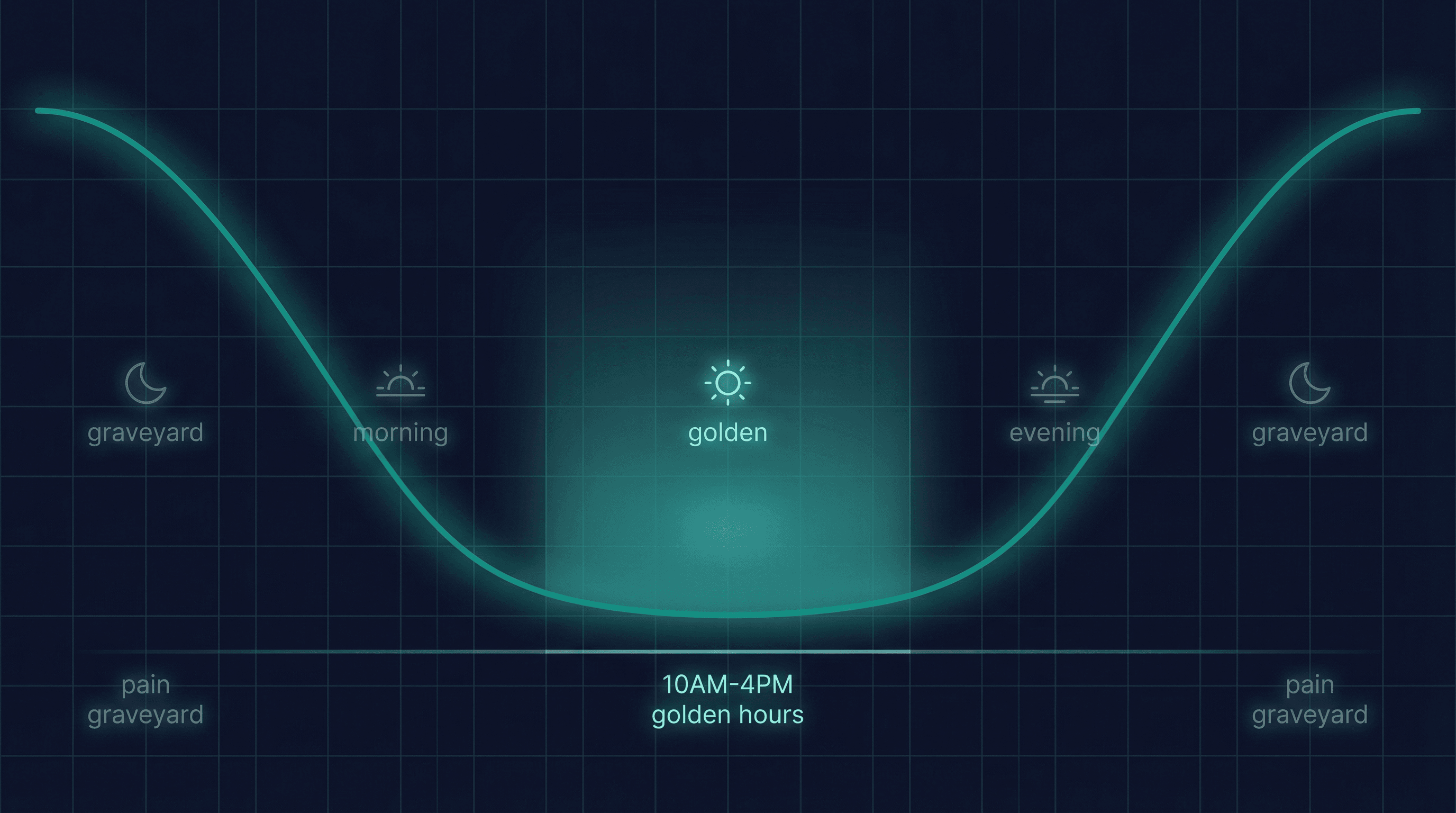
Fair scheduling algorithms start with a pain weight function: a mathematical curve that maps each hour of the day (0-23) to "sacrifice points" representing how disruptive that hour is. The function is based on chronobiology and work expectations:
Golden Hours (10am-4pm): 1 sacrifice point. These are peak cognitive hours for most people. The circadian rhythm is high, you've had caffeine/breakfast, and you're expected to be at work. A meeting here is just part of the job.
Morning/Evening Hours (8-10am, 4-6pm): 3 sacrifice points. You're either warming up or winding down. A meeting here disrupts either your routine or your personal time, but it's within reasonable work hours.
Early Morning (6-8am, 6-8pm): 6 sacrifice points. You're sacrificing sleep or personal time significantly. This is the boundary of "reasonable working hours."
Graveyard Shift (11pm-7am): 10 sacrifice points. You're actively fighting your circadian rhythm. Most sleep research shows that meetings in this window cause real damage to health and cognition.
The curve is smooth, not discrete. It reflects actual neuroscience: circadian rhythm dips are real, and asking your brain to perform at 3am costs real calories and health. One caveat: chronotype matters. A night owl at 5am might have a pain weight of 8, while an early bird has a pain weight of 3. Fair algorithms account for this, personalizing the pain weight per person based on their stated chronotype.
Minimize-Max-Sacrifice Optimization
Once you have pain weights for each person at each possible hour, the fairness algorithm becomes a classic optimization problem: minimize the maximum pain anyone experiences. This is called "minimax" optimization.
In plain English: find the meeting time that keeps the person with the worst timezone experience as comfortable as possible. If you have someone in Tokyo and someone in San Francisco, there is no time that's good for both. Tokyo at 9am is SF at 6pm the previous day. SF at 9am is Tokyo at 2am. The minimax algorithm finds the compromise time that minimizes the worst pain: roughly 8am SF / 1am Tokyo is better than 4am SF / 9pm Tokyo because it ensures no single person is at midnight or pre-dawn.
More formally, if we have n people and 24 possible hours, the algorithm calculates the maximum pain score (sum of all individual pain weights) for each hour, then selects the hour with the minimum maximum score. For recurring meetings, it goes further: it calculates a rolling fairness score. If you schedule the next meeting at your local golden hour, the algorithm "penalizes" you by increasing the expected pain weight for your next meeting, ensuring that over a month, no individual accumulates disproportionate sacrifice.
The elegance of minimax is that it guarantees no individual bears more than 1/n of the total pain, where n is the number of people. For teams across 3+ timezones with no perfect overlap, this fairness guarantee is impossible to achieve manually. Algorithms find it automatically.
Rotation Fairness Over Time
A single fair meeting time is good, but fairness across months is better. Consider a team with a weekly all-hands meeting. If the fair time for all three timezones is 8am San Francisco, then San Francisco gets the "win" every week—the meeting is during their business hours. London is at 4pm (reasonable). Tokyo is at 1am (brutal).
A fairness algorithm tracks cumulative sacrifice over time. It might say: "The first four all-hands meetings will be at 8am SF because that minimizes peak pain. Then, we rotate to 4pm GMT, which means Tokyo gets 6pm (reasonable), London gets 10am (golden), and San Francisco gets 10pm the previous night. Then, we rotate to 10am JST, which gives everyone a suboptimal time once every third meeting."
Over 12 weeks, each person gets three "wins" (meetings during their golden hours) and bears the cost of suboptimal times equally. This rotation creates a fairness property: the algorithm guarantees that no person accumulates more than 1/3 of the total cost. This is the "no dominant strategy" principle from game theory—nobody can game the system, so the team trusts the system.
For recurring weekly meetings, rotation intervals matter. A weekly meeting with 3-timezone rotation (rotating every 4 weeks) feels fair and predictable. People know "I'm on 11pm duty for 4 weeks, then I get golden hours for 4 weeks." A monthly meeting with no rotation feels increasingly unfair over time. A daily standup can't meaningfully rotate, so daily standups should ideally land in true overlap windows.
Why Algorithmic Fairness Beats Human Judgment
You might wonder: why not just ask humans to be fair? The answer is that unconscious bias is incredibly powerful in scheduling. Studies of human decision-makers consistently show that when distributing inconvenient times, people disproportionately assign them to lower-status individuals, satellite offices, or people who don't speak up. A leader in New York unconsciously schedules more 6am meetings for Tokyo teams than fair distribution would warrant. Even when trying to be fair, humans perform worse than a simple algorithmic approach.
An algorithm has no status bias. It doesn't unconsciously favor the leader's timezone. It doesn't weight "people who complained last time" differently. It treats every person's sacrifice equally. Over a large organization with hundreds of meetings per week, this bias-free approach creates measurably better outcomes: lower attrition in satellite offices, higher fairness perception scores, and better energy at meetings because people aren't fighting circadian rhythms as much.
Another advantage: transparency. When you show team members the sacrifice score calculation and the minimax logic, they understand why a meeting time was chosen. They can see that Tokyo is taking a hit this week, but London took it last week, and San Francisco will take it next week. This predictability and transparency build trust in the system in a way that human decision-making rarely achieves.
Sources and further reading
Related Articles
Ready to schedule meetings fairly?
Try ClockAlign free — see sacrifice scores, find golden windows, and build a more equitable meeting culture.
Get Started Free