Stop Making Tokyo Take the Midnight Calls: How to Rotate Meeting Times Fairly
A practical guide to fair meeting time rotation for global teams. Learn the minimize-max-sacrifice algorithm and rotation strategies with real examples.
The Unfairness Problem: Why Rotation Matters
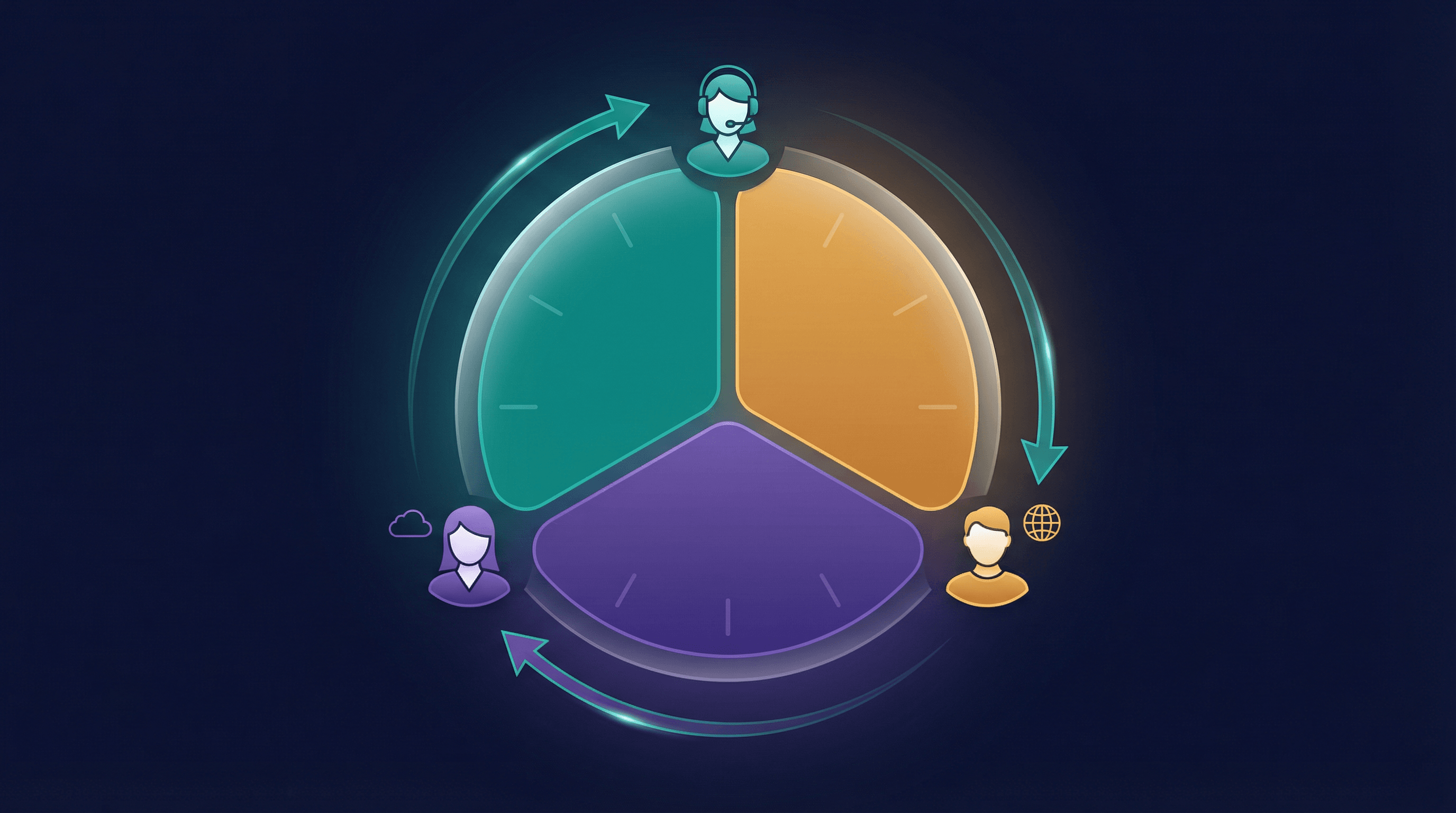
Here's a common pattern in distributed companies: one timezone consistently gets the good meeting times, and another always gets the terrible ones. Maybe the company was founded in San Francisco, so meetings default to Pacific Time. Or the CEO is in London and prefers Europe-friendly hours. The result is predictable and corrosive: the Tokyo team attends 6-7 late-night or overnight calls every week, while the San Francisco team gets morning-friendly times. Year after year, the same group pays the sacrifice.
This creates three concrete problems. First, it's physiologically harmful. Chronic sleep disruption has real health consequences. The Tokyo team members experience higher rates of burnout and health issues. Second, it's unfair in a way that erodes trust. "We say we value equity, but every week I'm taking midnight calls while they take 9 AM calls." This message about whose time and health matter is loud and corrosive. Third, it causes attrition. Talented people in hard-hit timezones quietly start looking for jobs at companies that treat them fairly.
The solution sounds simple: rotate meeting times. But many organizations attempt rotation badly. They rotate unpredictably (different time every week, creating chaos). Or they rotate inefficiently (spreading pain widely instead of minimizing it). Or they rotate incompletely (some meetings rotate while others don't, creating inconsistency). The result is chaos that feels worse than no rotation at all.
Fair rotation requires a strategy. It means being intentional about which meetings rotate, how often, and according to what pattern. It means communicating clearly so people know when their meeting is and why.
The Minimize-Max-Sacrifice Algorithm
Before we talk about rotation strategies, let's talk about a guiding principle: minimize maximum sacrifice. The idea is that you're trying to design a rotation pattern that keeps the highest sacrifice anyone experiences as low as possible. It's the "least unfair" approach.
Here's how it works mathematically. For each person and each proposed meeting time, calculate their sacrifice score. For each time option, identify the person with the highest sacrifice (the "max"). Your goal is to choose the time where that max sacrifice is as low as possible. Then, for recurring meetings, you rotate so that you keep cycling through times where the max is roughly equal.
Example: You have a global team with people in San Francisco (UTC-8), London (UTC+0), and Singapore (UTC+8). You need a one-hour weekly meeting. Let's evaluate three proposed times:
Option A: 8 AM Pacific (4 PM London, midnight Singapore). Sacrifice scores: SF = 1, London = 2, Singapore = 9. Max = 9. This is brutal for Singapore.
Option B: 5 PM Pacific (1 AM London, 9 AM Singapore). Sacrifice scores: SF = 3, London = 8, Singapore = 1. Max = 8. Better for Singapore but brutal for London.
Option C: 1 PM Pacific (9 PM London, 5 AM Singapore). Sacrifice scores: SF = 2, London = 5, Singapore = 6. Max = 6. No single person is destroyed; pain is distributed.
Option C has the lowest maximum sacrifice (6 vs 9 vs 8), so it's the "minimize max sacrifice" choice. In practice, you might choose C for weeks 1-2, then Option B for weeks 3-4, then Option A for weeks 5-6, rotating every two weeks. This way, no one geography is always the victim, and the maximum sacrifice in any given week is 8 at worst (when it's London's turn to suffer), which is worse than the standing Option C, but the rotation is fair over time.
This approach is mathematically fair: if you have three timezones, each one gets the "best" time once every three rotation cycles. For teams with four or more timezones, the math gets more complex, but the principle holds.
Rotation Strategies That Actually Work
The 3-week rotation (for weekly meetings with 3 timezones). This is the most common pattern for teams with Americas/Europe/Asia spread. Week 1 is Americas-optimal time (e.g., 9 AM Pacific). Week 2 is Europe-optimal (e.g., 4 PM UTC). Week 3 is Asia-optimal (e.g., 9 AM Singapore = 1 PM UTC = 6 AM Pacific). Everyone gets their "good slot" once every three weeks. Everyone gets one "bad slot" where they're either early morning or evening, and one "medium slot." This feels fair and is easy to remember.
The 2-week rotation (for 2-timezone teams). If you have exactly two major timezone clusters (US and Europe, or US and Asia), a simple two-week rotation is clean. Week 1: US time. Week 2: Europe/Asia time. Simple, predictable, fair. Each side gets equal treatment.
The bi-weekly offset (for teams where one meeting is larger than others). Some teams have one "big" meeting (all-hands) and several smaller meetings. The all-hands might rotate on a 3-week cycle because it's rare enough and important enough that everyone will tolerate one bad slot per month. Smaller team meetings might be kept within a single timezone (US team calls are always Eastern time, Asia team calls are always Singapore time). This balances fairness with practicality.
The split-time pattern (for irreconcilable spreads). If your team is so globally distributed that no single time works reasonably for everyone, consider splitting the meeting. The all-hands happens at 8 AM Pacific for Americas + Europe, then again at 5 PM Pacific for EMEA and Asia. This doubles the meeting load on you as organizer, but everyone gets a reasonable time. For truly important, all-hands moments, this might be worth it.
The "meeting-free week" pattern (for heavy meeting loads). Some teams say: "This meeting rotates 3 weeks, but every fourth week is a meeting-free week for that time slot." So you might have a team sync at 8 AM Pacific for week 1, 5 PM UTC for week 2, 9 AM Singapore for week 3, and then no call in week 4 (people get time back). This isn't rotation per se, but it distributes the pain differently.
Real-World Examples: US/Europe/Asia Teams
Example 1: The three-timezone standup. A 30-minute daily standup with 5 people in SF, 3 in London, 2 in Singapore. Using the 3-week rotation: Week 1 is 8 AM Pacific (SF golden hours, London OK at 4 PM, Singapore brutal at midnight). Week 2 is 2 PM UTC (SF suboptimal at 6 AM, London optimal, Singapore suboptimal at 10 PM). Week 3 is 1 AM UTC (SF 5 PM previous day acceptable, London 1 AM rough, Singapore 9 AM optimal). The pain is distributed: each timezone gets one easy week, one medium week, one bad week. Over 12 weeks, each timezone has four "easy" slots and four "bad" slots. This is fair.
Example 2: The biweekly all-hands. 40-person company, significant US and Europe presence, small Singapore office. Instead of a complex 3-week rotation, they do a simpler 2-week rotation: alternating between 8 AM Pacific (good for US, okay for Europe, bad for Singapore) and 4 PM UTC (okay for US, good for Europe, bad for Singapore). Singapore never gets a golden slot in this rotation, which sucks, but it's relatively rare (biweekly means only one all-hands per week), and they address the inequity by: 1) recording the all-hands so Singapore can watch async, 2) publishing detailed notes, and 3) having a separate monthly "ask me anything" session at 9 AM Singapore time (midnight Pacific, morning London) with the CEO — a much smaller, higher-engagement event that Singapore gets priority on.
Example 3: The team-based clustering approach. A 60-person company with 25 in SF, 25 in London, 10 in Singapore. Instead of trying to rotate everything, they segmented: SF team meetings are 9 AM Pacific (within-timezone). London team meetings are 10 AM UK (within-timezone). Singapore team meetings are 2 PM Singapore (within-timezone). Cross-team meetings that involve 2+ regions rotate: Americas-Europe meetings rotate weekly. Asia-specific meetings can be scheduled at reasonable times for Asia. The monthly all-hands is the only truly global meeting and it happens at 8 AM Pacific (Singapore pain) on a quarterly basis with rotating structure (maybe every other quarter it's recorded async). This approach reduces the number of people taking truly painful meetings.
Implementing Rotation: Communication and Clarity
A rotation system only works if people remember it. Many organizations attempt rotation but fail because the pattern is confusing or inconsistent. "Is this meeting on the rotation? When is it? When does it rotate?" If the answers aren't crystal clear, your team will spend more energy tracking the rotation than they save by having a fair system.
Solution: publish a "meeting matrix" — a simple document or spreadsheet that lists every recurring meeting and its rotation pattern. For each meeting, include: meeting name, rotation cycle (2-week, 3-week, etc.), the specific times for each cycle, when the rotation began, and when the next rotation happens. This takes 15 minutes to create and saves your team dozens of hours of confusion.
Example format:
Weekly Standup
Rotation: 3-week cycle
Week 1 (next on Feb 17): 8 AM Pacific (SF golden, London 4 PM, Singapore midnight)
Week 2: 2 PM UTC (SF 6 AM, London optimal, Singapore 10 PM)
Week 3: 1 AM UTC (SF 5 PM prev day, London 1 AM, Singapore 9 AM optimal)
Duration: 30 minutes
Then publish this matrix and link it from your calendar invites and team handbook. When someone asks "When is the standup?" the answer is "Check the meeting matrix, and if you see [rotation week], you'll know the time."
Also communicate the why. "We rotate this meeting to be fair to all timezones. You'll get a great time once every three weeks, a medium time once, and a hard time once. Over a quarter, the burden is balanced." This helps people accept the rotation even when it's their bad week. They know it's temporary and fair.
Finally, be consistent. Don't skip a rotation. Don't change the schedule ad hoc. If you say the meeting rotates every 3 weeks on Monday, don't suddenly move it to Wednesday. Consistency is how people trust the system.
Measuring Fairness: Sacrifice Score Audits
Once you've implemented rotation, measure it quarterly. Add up the total sacrifice scores for each person over the quarter. In a perfectly fair system with a 3-week rotation and 3 timezones, each person should have roughly equal total sacrifice. In practice, there will be variation (some meetings don't rotate, some people have more meetings), but you should see rough balance within 10-20%.
If you notice that one timezone has absorbed significantly more pain (e.g., Singapore is at 1,500 sacrifice points for the quarter while SF is at 800), that's a signal that your rotation isn't working. Either the rotation pattern isn't actually being followed, or you have non-rotating meetings that are skewed toward one geography, or you've made scheduling decisions that favor one timezone.
Use this audit to course-correct. "We notice Asia absorbed 40% more sacrifice than other regions this quarter. Let's audit our non-rotating meetings and see if any should be rotated. Also, let's check if we can shift two of the fixed-time meetings to rotate." Small adjustments accumulate into real fairness improvements.
Also ask your team qualitatively: "How does this rotation feel? Are there particular meetings that are consistently bad for you? Would a different rotation pattern work better?" Fairness is both mathematical and perceived. A system that's technically fair but feels unfair will breed resentment. A system that people feel is fair will build trust even if the math isn't perfect.
Sources and further reading
Related Articles
Ready to schedule meetings fairly?
Try ClockAlign free — see sacrifice scores, find golden windows, and build a more equitable meeting culture.
Get Started Free