Golden Windows: How to Find the Best Meeting Times for Global Teams
Explore the science of golden windows — the optimal periods where your global team can meet with the highest energy and engagement.
What Is a Golden Window?
A golden window is a period of time where the maximum number of people on your team are simultaneously in their peak productivity hours. It's not just about timezones overlapping — lots of timezones overlap. A true golden window is when people are awake, alert, energized, and available. For a globally distributed team, golden windows are often narrow and sometimes nonexistent, but identifying them is crucial for scheduling your most important meetings.
The concept combines three elements: first, time of day for each person's local timezone (Are they in their peak energy hours?). Second, actual overlap (Is it a reasonable time for everyone, or is someone at 3 AM?). Third, availability (Is this a time people are likely to be actually working, not in commutes or personal time?). A time might technically overlap all timezones but be 6 AM for half the team — that's not really a golden window because people are groggy and rushing to get ready.
For teams with small geographic spread (e.g., US only, or Europe only), golden windows are easy to find — often several hours per day. For globally distributed teams with 12+ hour spreads, true golden windows might be 30 minutes to 2 hours per day, or might not exist at all on a 24-hour clock. Understanding whether golden windows actually exist in your team's geography is the first step to smart scheduling.
The Science of Energy Curves and Chronotypes
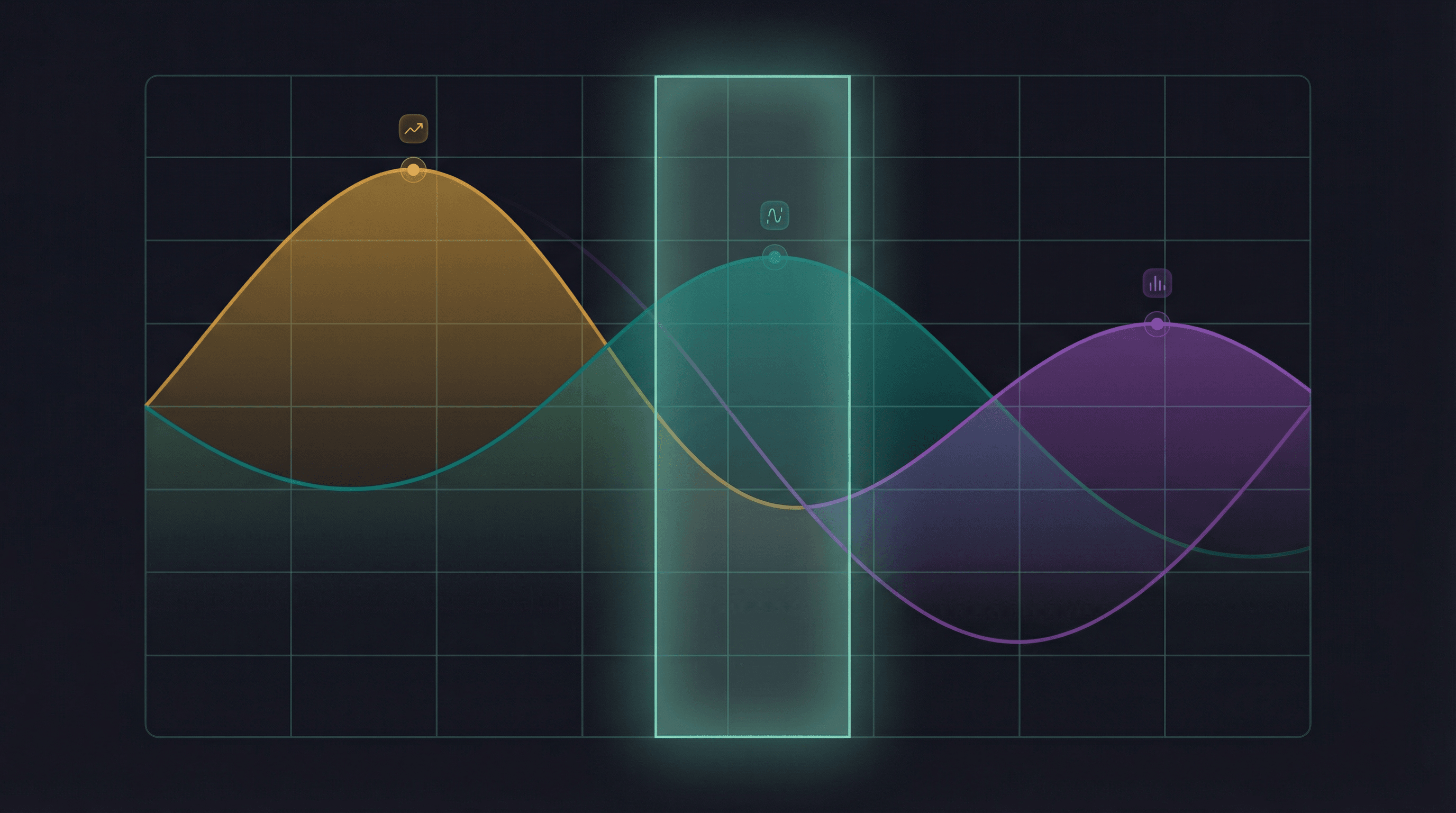
Human energy and alertness follow predictable patterns throughout the day, governed by circadian rhythms. The research shows that most people have a sharp rise in alertness in the morning (cortisol peaks), a plateau during mid-morning through early afternoon, a dip after lunch, a secondary rise in early evening, and then a decline toward sleep. The exact timing varies between individuals based on chronotype — your natural tendency toward early rising or late sleeping.
Chronotypes fall into three broad categories. Early birds (about 15-20% of the population) naturally wake up at 5-6 AM and hit peak productivity by 8-9 AM. They're sharp through mid-afternoon but fade by evening. Night owls (another 15-20%) naturally sleep until 8-9 AM, hit peak productivity around 11 AM through 3 PM, and don't really wake up until afternoon. The middle group (the majority) is somewhere in between, typically peaking 10 AM to 3 PM.
In a globally distributed team, you also have a second layer of chronotype variation: natural timezone chronotype. Someone in London at 8 AM is in a very different physiological state than someone in San Francisco at 8 AM. The San Francisco person is still waking up (early morning chronotype). The London person is in mid-morning (optimal). Sophisticated scheduling systems account for both personal chronotype and timezone-induced time-of-day effects.
The practical implication: meetings scheduled during true golden windows — where people are in their peak energy across multiple timezones — have demonstrably better outcomes. People are more engaged, ideas flow more freely, decisions are better. Meetings scheduled in low-energy windows feel like pulling teeth. The time itself is wasted because people are checked out. This is why identifying golden windows matters beyond just fairness — it affects meeting quality and effectiveness.
Identifying Golden Windows in Your Team
Start by mapping your team's geography and their typical working hours. If most people work traditional hours (9 AM to 5 PM local time), then golden windows are periods where multiple timezones have overlap in that window. For a US-Europe team with 5 hours of time difference, you typically get a 2-3 hour window where both coasts have reasonable hours (e.g., 8-11 AM Pacific = 4-7 PM London). For Asia involvement, the windows often compress to minutes or disappear entirely.
Next, apply chronotype considerations. If your team has a significant early-bird population, you might be able to shift golden windows earlier. If you have many night owls, windows shift later. A team with global chronotype diversity (some early birds, some owls, some normal) has more flexibility. A team with uniform chronotypes (many early birds) has less flexibility because everyone's peak is at the same time, which might not overlap with distant timezones.
The gold-standard approach is to survey your team about their actual energy patterns and preferences. Don't assume. Ask: "When are you most sharp? When do you prefer to have focus time? What times are difficult?" You'll often discover that someone who sits in a timezone that "should" be golden hours is actually a night owl who doesn't fully wake until 11 AM. Or that someone in a typically hard timezone is an early bird who's sharp at 5 AM. This individual variation matters more than you'd expect.
The Quality Score Formula
Many scheduling systems use a "quality score" to evaluate how good a proposed meeting time is. Quality scores typically weight four factors: first, average energy (How alert are people on average?), weighted at 40%. Second, minimum energy (What's the worst anyone will feel?), weighted at 30% — because even one person in terrible shape hurts meeting quality. Third, availability (Can people actually attend?), weighted at 20%. Fourth, evenness (Is the distribution fair across geographies?), weighted at 10%.
Let's walk through an example. Suppose you're considering 8 AM Pacific for a global team. In Pacific time, that's golden hours (energy: 8/10). In Eastern, it's 11 AM (energy: 9/10). In London, it's 4 PM (energy: 6/10 — afternoon slump). In Asia, it's midnight to 2 AM (energy: 1/10 for anyone attending). Average energy: (8+9+6+1)/4 = 6/10. Minimum energy: 1/10. This is a poor-quality time because of Asia.
Now consider 5 PM Pacific instead. Pacific: 5 PM (energy: 4/10 — end of day fade). Eastern: 8 PM (energy: 3/10). London: 1 AM (energy: 1/10). Asia: 9 AM (energy: 7/10). Average: 3.75/10. Minimum: 1/10. It's marginally worse overall, but it's similarly bad, so you might choose based on other factors (like which geography is bigger). The point is that you now have data to compare, rather than guessing.
The availability factor is also important. If your proposed golden window is 8-9 AM Pacific, but 40% of your Asia team has commute time until 8:30 AM local time, the actual availability drops. The quality score captures this too. True golden windows have high scores because they're genuinely good times — people are energized and actually present.
Strategies When Golden Windows Are Small or Nonexistent
For many global teams, true golden windows are tiny or don't exist at all. If your team spans San Francisco to Singapore, there might be a 30-minute window early morning Pacific that's barely usable. This is the reality for many companies, and it requires strategic thinking rather than despair.
Strategy one: accept that some meetings will have pain, but minimize it through rotation. Don't schedule all your meetings in the same narrow window — spread them across time, so that the pain is distributed. Your all-hands might be Monday at 7 AM Pacific (painful for Asia, okay for US). Your team sync might be Wednesday at 5 PM Pacific (painful for US, okay for Asia). The individual meetings have pain, but no single geography is always sacrificing.
Strategy two: split meetings into regional cohorts plus async. Your monthly all-hands might happen at 8 AM Pacific for the Americas and Europe, then again at 5 PM Pacific for Asia and late-night Europe. Yes, you're repeating the meeting, but everyone gets a reasonable time. For sensitive discussions or decisions, you then have async follow-up where all regions can weigh in before final decisions. This trades synchronous coordination burden for meeting quality and fairness.
Strategy three: shift to async-first for meetings that must include distant timezones. An urgent discussion that includes San Francisco and Tokyo is genuinely hard to schedule. But many such discussions don't need to be synchronous. A Loom video explaining the situation, followed by Slack discussion, followed by a sync decision call 24 hours later, often works better than trying to drag everyone into the same live call at an awful time.
Strategy four: invest in tools and practices that make the most of limited golden windows. If you have 45 minutes of true golden window each day, be ruthless about what happens in that time. It should be your highest-priority decisions and discussions. Less critical conversations happen async. This discipline makes golden windows valuable enough to protect.
Measuring and Optimizing Golden Windows
Once you've identified golden windows, measure them. Track what percentage of your team meetings happen in true golden windows versus suboptimal times. Many organizations discover that only 10-15% of their meetings are in golden windows, even though they think they're trying. This data is actionable. "We're currently scheduling only 12% of our meetings in high-quality times. Can we restructure to reach 40%?" is a concrete goal.
Also measure energy perception. After meetings, ask people: "Did you feel alert during this meeting? Did you stay focused?" Over time, correlate this feedback with meeting time. You'll likely see that meetings in golden windows have dramatically higher engagement. This reinforces the value of protecting those windows for important work.
Finally, iterate. Every quarter, review your golden window strategy. Have timezone preferences changed? Did someone move? Did you hire in a new region? Do you have new chronotype data from team surveys? Adjust your approach. The goal isn't to find a perfect schedule that never changes — it's to continuously improve how you're using your limited golden windows.
Sources and further reading
Related Articles
Ready to schedule meetings fairly?
Try ClockAlign free — see sacrifice scores, find golden windows, and build a more equitable meeting culture.
Get Started Free