How to Calculate Timezone Overlap for Your Global Team
Learn how to manually calculate timezone overlap and discover common overlap windows for popular timezone combinations. Plus, understand what to do when your team has zero overlap.
What Is Timezone Overlap and Why Does It Matter?
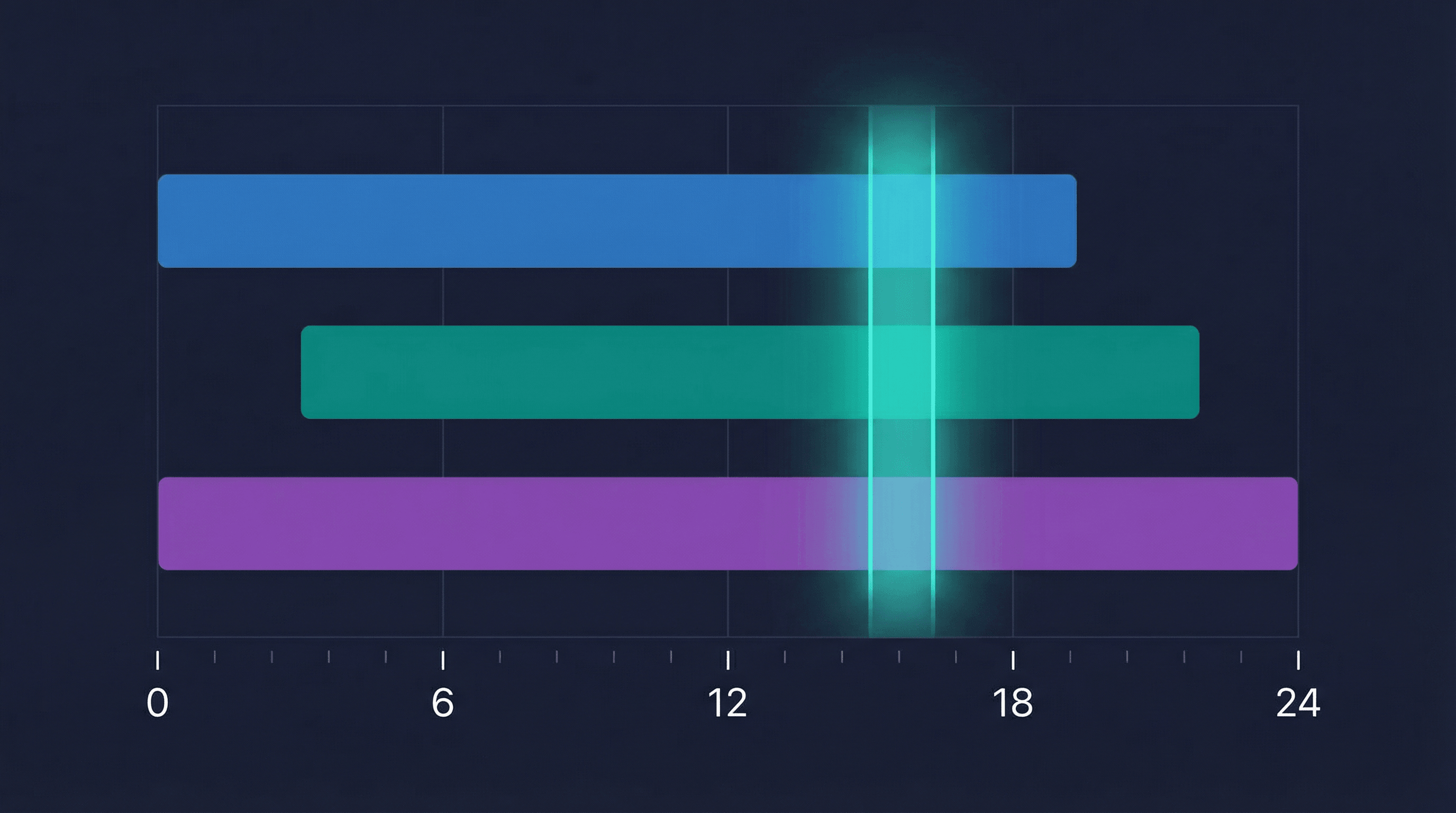
Timezone overlap is the window of time when all (or most) of your team members are working simultaneously. If your US-based team starts work at 9am EST and your London team ends at 5pm GMT, your overlap window is roughly 2-3 hours: 9am-12pm EST = 2pm-5pm GMT. This overlap is where synchronous collaboration happens—meetings, pair programming, real-time problem-solving.
Timezone overlap matters because it directly impacts team velocity and wellbeing. With generous overlap, you can have quick standup meetings, make decisions faster, and build team cohesion. With zero overlap, every decision takes 24+ hours, and team members who always join meetings outside their working hours burn out. Most distributed teams operate with reduced overlap, not zero, but understanding your actual overlap window helps you use it strategically.
The Manual Calculation Method
Here's how to calculate timezone overlap for any two locations. First, write down the working hours for each person in their local time. Let's use an example: Alice in San Francisco (PST, UTC-8) works 9am-6pm. Bob in London (GMT, UTC+0) works 9am-5pm.
Next, convert one person's hours to the other's timezone. Bob's 9am-5pm GMT becomes 1am-9am PST (8 hours behind). Now compare: Alice works 9am-6pm PST, Bob works 1am-9am PST. The overlap is 9am-9am... which is zero. They have no overlap. But if Bob shifts his hours to 2pm-10pm GMT (which is common for London teams serving US clients), that becomes 6am-2pm PST, giving Alice and Bob a 6am-9am PST overlap window.
For three or more people, the math gets tighter. Each additional timezone usually shrinks the overlap window. The overlap becomes the intersection of all working hour ranges across all timezones. With four people across US West, US East, Europe, and Asia, you might have just 30-60 minutes of true overlap when everyone is awake and working.
Common Timezone Combinations and Overlap Windows
US East Coast + London: EST (UTC-5) and GMT (UTC+0) are 5 hours apart. If EST works 9am-6pm and GMT works 9am-5pm, overlap is 9am-12pm EST (1pm-4pm GMT). This is a tight 3-hour window but very manageable. Many US/UK teams do their morning standups in this window.
US West Coast + Tokyo: PST (UTC-8) and JST (UTC+9) are 17 hours apart—which is brutal. A 9am-6pm PST workday becomes 2am-11am JST the next day. A 9am-5pm JST workday becomes 4pm-12am PST the previous day. These two zones are almost entirely opposite. Overlap requires one side to work early morning or one side to work late night. Many SF-Tokyo teams accept zero daytime overlap and run async-first.
London + Singapore: GMT (UTC+0) and SGT (UTC+8) are 8 hours apart. London 9am-5pm is Singapore 5pm-1am. This is actually reasonable: London can have their afternoon standup during Singapore's evening overlap window. These teams usually get 4-6 hours of overlap.
US West + London + Singapore: Add all three together and you get almost zero overlap. PST (UTC-8), GMT (UTC+0), and SGT (UTC+8) span 16 hours. There might be 30 minutes where all three are nominally "working," but it's early morning for SF, evening for London, and late night for Singapore. Teams spanning this far almost always go async-first.
When Overlap Is Zero: What To Do
If your team has zero daytime overlap—common for West Coast / Tokyo teams or any 3+ timezone setup—don't panic. Zero overlap is manageable; it just requires different strategies. First, accept that synchronous meetings will require someone to join outside business hours. Be transparent about this cost. If someone joins at 6am or 9pm regularly, build that into their schedule formally, don't sneak it in.
Second, invest in asynchronous communication. Use recorded video updates instead of live meetings. Create a culture where important decisions don't wait for a meeting—they're made via documented feedback loops. Tools like Slack, Loom, and written RFCs (Request for Comments) become essential. This is actually often more efficient than cramming 3+ people into a 30-minute meeting across bad timezone conditions.
Third, use your zero-overlap time as a feature, not a bug. Overnight work by one timezone can be reviewed and approved the next morning by another timezone. This creates a 24-hour feedback loop that can actually accelerate work. Many distributed teams with zero overlap report higher async velocity than teams with partial overlap that fall into the trap of "we'll just email about it" despite having a tight 2-hour meeting window.
Tools and Calculators to Help
World Time Buddy is the gold standard for quick timezone conversion. You can drag a slider and instantly see what time a meeting is across 20+ zones. It's free and requires no signup. Timezone.io is similarly lightweight. Both tools are perfect for the "what time is 3pm PST in Tokyo" lookup.
For teams, ClockAlign goes beyond just showing times. It calculates your team's actual overlap window, shows you the sacrifice cost of different meeting times, and helps you schedule in golden windows when everyone is actually sharp. If you want to optimize not just for overlap, but for fairness and energy levels, ClockAlign's calculator factors in each person's chronotype preferences and past meeting load.
Sources and further reading
Related Articles
Ready to schedule meetings fairly?
Try ClockAlign free — see sacrifice scores, find golden windows, and build a more equitable meeting culture.
Get Started Free